
Douglas firs, cedars and big leaf maples are part of what makes Eastside neighborhoods feel the way they do. They're also why gutters here fill faster than almost anywhere. Needles and cones fall all year, leaves pile on in fall, and moss grows on shaded roofs. A gutter that's packed when the November rains arrive sends water exactly where you don't want it: over the edge beside the foundation, back under the roof edge, or down the inside of a wall.
How Do Clogged Gutters Cause Water Damage Inside?
Three ways:
- Overflow at the foundation. Water spilling over the front of the gutter lands right next to the house, saturating the soil against basement and crawl-space walls.
- Backup at the roof edge. When a gutter is full, water can work back under shingles and the drip edge, soaking the fascia and the top of the wall.
- Downspout failures. A blocked or disconnected downspout dumps a whole roof section's water in one spot, often beside a lower-level wall.
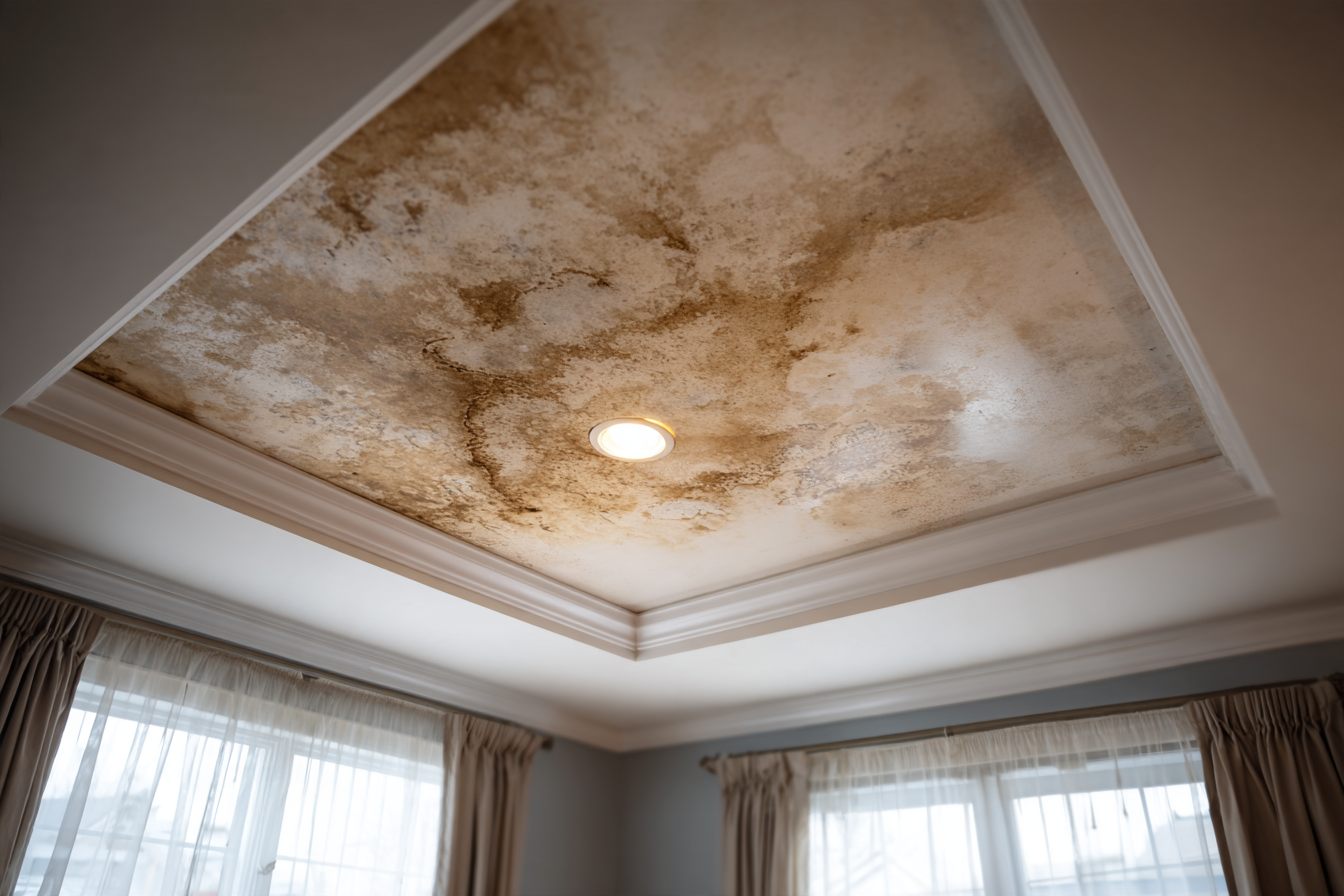
The interior signs show up as stains on ceilings near exterior walls, damp carpet along a lower-level wall, or peeling paint high on a wall.
Ceiling stain near an outside wall after rain?
Talk it through with a local restoration company: (425) 437-2143.
Call (425) 437-2143A Routine for Tree-Heavy Lots
| When | What to do |
|---|---|
| Early fall | Clean gutters and downspouts before the first long rain |
| Late fall | Clean again after most leaves have dropped |
| Midwinter | Check after big windstorms, which shake loose needles and branches |
| Spring | Clean and check for sagging sections, loose hangers and moss |
| Every storm | Watch where downspouts discharge; water should move away from the house |
Gutter guards help with leaves but not always with fir needles, which can mat on top of screens. Downspout extensions or underground drain lines that carry water several feet from the foundation make a bigger difference than most people expect.
Moss and Roof Edges
Shaded roofs under big trees grow moss, and moss holds water against shingles and lifts their edges. Over a few winters, that can let water under the roofing near the eaves, especially where the gutter is already full. Moss also breaks loose in storms and washes into gutters and downspouts, where it's one of the most common causes of clogs. A roofer can treat and remove it; scraping it hard yourself can damage the shingles.
Downspouts That Disappear Underground
Many Eastside homes have downspouts that connect to buried pipes running out to the street, a ditch or a dry well. When those pipes clog with needles, roots or silt, water backs up and pours out at the joint near the foundation, often unseen behind a shrub. If a downspout overflows at the top during heavy rain, or the ground near its base stays soggy, the underground line is probably blocked. A drainage contractor can clear or replace it.
How Often Should Gutters Be Cleaned Under Evergreens?
At least twice a year for most Kirkland lots, and three or four times for homes under large firs or cedars. The busy times are before the first long fall rain, after the leaves drop, and after any big windstorm. Look at the gutters from the ground during heavy rain: water spilling over the front edge, or no water coming out of a downspout, means there's a clog.
Where the Overflow Shows Up Inside
Gutter water tends to leave a trail. Above the eaves, it soaks the attic insulation along the outside wall and stains the top of the drywall in the rooms below, usually in a corner or along the ceiling line. Lower down, it saturates the soil beside the foundation and appears as damp carpet along a basement wall, a wet crawl space under that side of the house, or water in a window well. If a stain lines up with a gutter run or a downspout outside, that's usually the cause. A restoration company can confirm it with moisture readings, then dry the attic, wall or lower level while a gutter service or roofer deals with the outside.
Ladders and Safety
Gutter cleaning sends a lot of people to the emergency room every year. If the roof is steep, high or wet, hire a gutter service. And if water is already coming into the house, the gutter can wait; the inside of the house can't.
Is Gutter Overflow Covered by Insurance?
Sometimes. Sudden interior damage from water entering through the roof edge may be covered. Gradual seepage into a foundation, or damage traced to long-term neglect, often isn't. Photograph the gutter and the interior damage before anything is cleaned up. See moisture logs.
After Water Gets In
Roof-edge water usually soaks attic insulation and the top of the drywall; foundation overflow soaks lower-level walls and flooring. Both need measuring and drying, not just a fan. The process: ceilings & upper floors and basements & crawl spaces.
Where Gutters Work Hardest
Wooded lots in Rose Hill, Market & Norkirk and Finn Hill, and the larger lots around Woodinville and Bridle Trails.

Hillside Lots and Water at the Uphill Wall
How runoff on a slope ends up inside a lower level.
Upstairs Leaks in Two-Story Homes
Laundry rooms and bathrooms over living space.