The Most Common Water Damage Inside a House
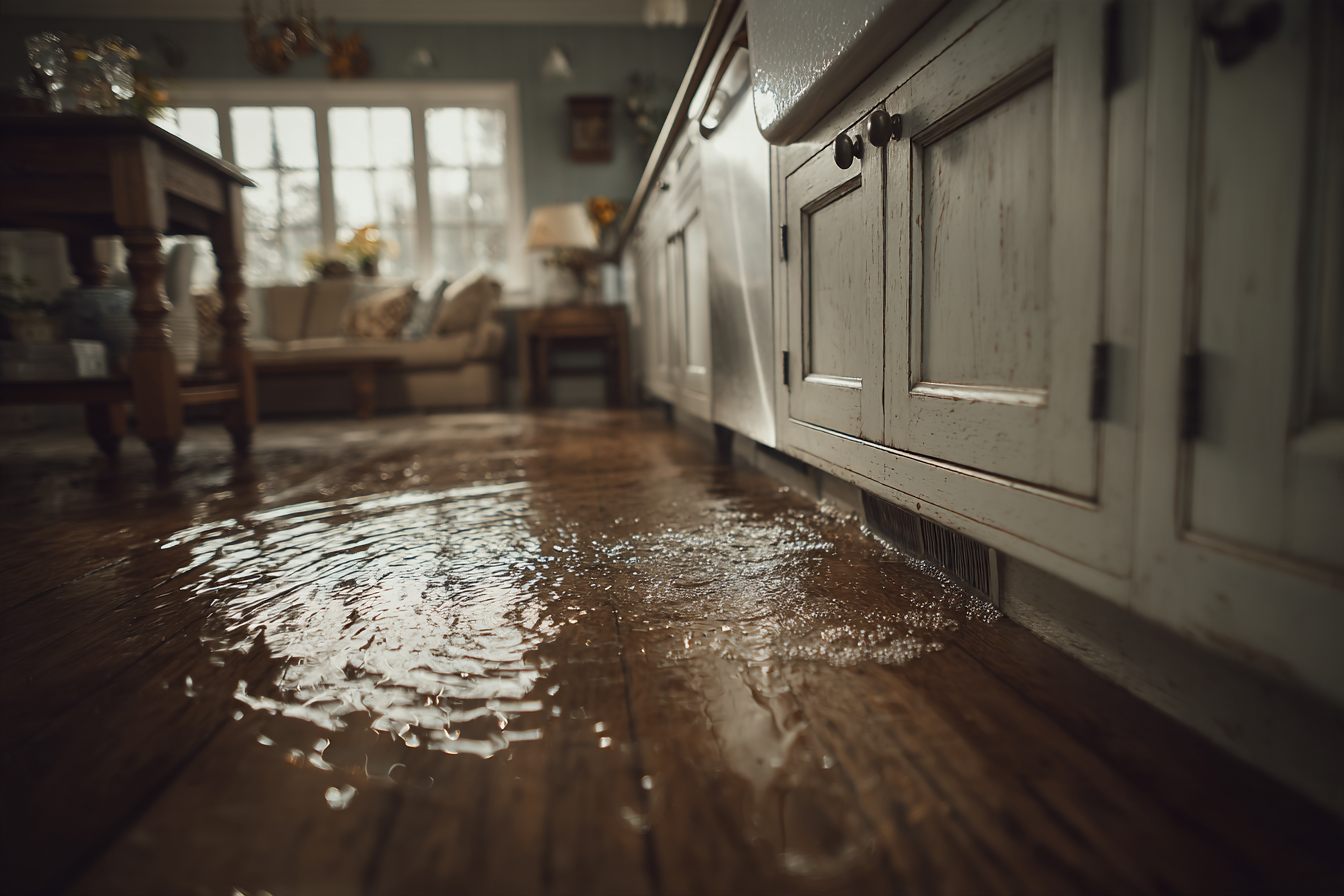
Fixture and appliance leaks cause a large share of indoor water damage on the Eastside, in every season. A supply line or hose under household pressure releases water fast; a slow drip under a sink can run for weeks. Either way, water gets under cabinets, into the subfloor and through the wall into the next room. Drying it properly, with readings, is what keeps cabinets and floors from swelling later.
Fixture by Fixture
| Fixture | What usually fails | Where the water goes |
|---|---|---|
| Dishwasher | Supply line, drain hose, door seal | Under the dishwasher and the cabinets beside it |
| Refrigerator | Ice-maker or water line | Behind and under the fridge, often under flooring |
| Kitchen sink | Supply lines, drain connections, disposal | Into the sink base and down to the subfloor |
| Toilet | Supply line, fill valve, wax seal | Into the floor and the ceiling below |
| Tub and shower | Valve or drain behind the wall | Inside the wall cavity, then the ceiling below |
| Washing machine | Rubber hoses, drain overflow | Laundry floor, then adjoining rooms or the floor below |
Water under the cabinets or behind the washer?
Talk it through with a local restoration company: (425) 437-2143.
Call (425) 437-2143Cabinets and Toe Kicks
Water that gets under base cabinets is out of sight and out of the airflow. Restoration crews often remove the toe kicks, the strip along the bottom, so air can reach the floor beneath, and sometimes drill small vents. Solid wood cabinets frequently survive. Particleboard boxes and sink bases that have swelled usually don't, and replacing a few boxes beats replacing a whole kitchen because the subfloor stayed wet.
Floors Under Appliances
Kitchens and laundry rooms in Eastside homes often have hardwood, engineered planks or luxury vinyl. Water spreads under all three. Hardwood may cup and then flatten with careful drying; engineered and laminate products vary more. Read hardwood and engineered floors after water for how those calls are made.
Can Kitchen Cabinets Be Saved After a Leak?
Often, if the cabinets are solid wood and drying starts quickly. Particleboard that has swollen rarely recovers. The deciding factors are the material, how long it was wet and whether water got inside the boxes.
Water Damage Cleanup, From Leak to Dry
Water damage cleanup after a fixture leak follows the same order every time: stop the water, extract it, dry with readings, then repair. If water is standing, extraction comes first. If it came through a ceiling from a bathroom or laundry room above, see ceilings & upper floors. The drying and rebuild are on drying & repairs.
Slow Leaks Do Their Own Kind of Damage
A burst washer hose is obvious. A drip at a sink connection, a toilet seal that seeps a little with every flush, or a pinhole in a supply line behind the fridge isn't. Those leaks can run for weeks, and by the time they're found the subfloor may be dark and soft, the bottom of the cabinet box swollen, and the drywall behind the toilet stained.
Slow leaks matter for two reasons. The damage goes deeper, because water has had time to soak into dense materials. And insurers treat them differently: many policies cover sudden, accidental water and exclude damage from long-term seepage. Photos of the failed part and the restoration company's readings help show what happened. See moisture logs.
Signs to watch for: a cabinet floor that's warped or stained, a toilet that rocks, grout that keeps cracking around a tub, a musty smell under the sink, or a water bill that's higher than it should be.
Bathrooms: The Water Behind the Tile
Tile and grout look waterproof, but most leaks in bathrooms happen behind them. A shower valve inside the wall, a cracked drain fitting under a tub, or failed caulk where the tub meets the wall lets water into the cavity, where it soaks the backer board and framing. In a main-floor bathroom, it shows up as loose tile, a stain on the hallway side of the wall, or a damp spot in the basement or crawl space below. In an upstairs bathroom, the ceiling below usually tells first.
Drying a bathroom wall usually means opening the drywall on the side opposite the tile, or the ceiling below, rather than removing the tile itself. Whoever fixes the plumbing does the repair; the restoration company dries what got wet and puts the opening back.
Laundry Rooms Upstairs and Down
Washing machine hoses are under constant pressure whether or not the machine is running, and old rubber hoses split without warning. On a main floor or in a garage, the water spreads across the floor and under the walls into adjoining rooms. On an upper floor, it goes down through the ceiling. A clogged drain standpipe is the other common failure: it overflows a little every cycle, and the floor framing slowly gets wetter.
Replacing rubber hoses with braided stainless ones, adding a drain pan, and putting a leak sensor behind the machine are all inexpensive. After a failure, though, the job is extraction and drying, and that's the call to make.
Water Heaters in Garages and Closets
Water heaters are in the same family of failures. A tank that rusts through at the bottom can leak slowly for days or let go all at once, and a failed relief valve or a loose fitting at the top can spray water across a closet. In a garage, the water usually spreads across the slab and under the door into the house. In an interior closet or an upstairs utility room, it goes into the walls and the floor below. Most tanks give some warning: rust at the base, water in the drain pan, popping noises, or rusty hot water. When one does leak, shut off the cold-water supply to the tank, turn off its power or gas, and phone for extraction and drying.
Fixture Leak Cleanup Around the Lake
Kirkland
- Finn HillKirkland
- JuanitaKirkland
- KingsgateKirkland
- Totem LakeKirkland
- Rose HillKirkland
- HoughtonKirkland
- LakeviewKirkland
- Moss BayKirkland
- Market & NorkirkKirkland
- Bridle TrailsKirkland
Nearby